Why Most Incident Response Fails in the First 30 Minutes
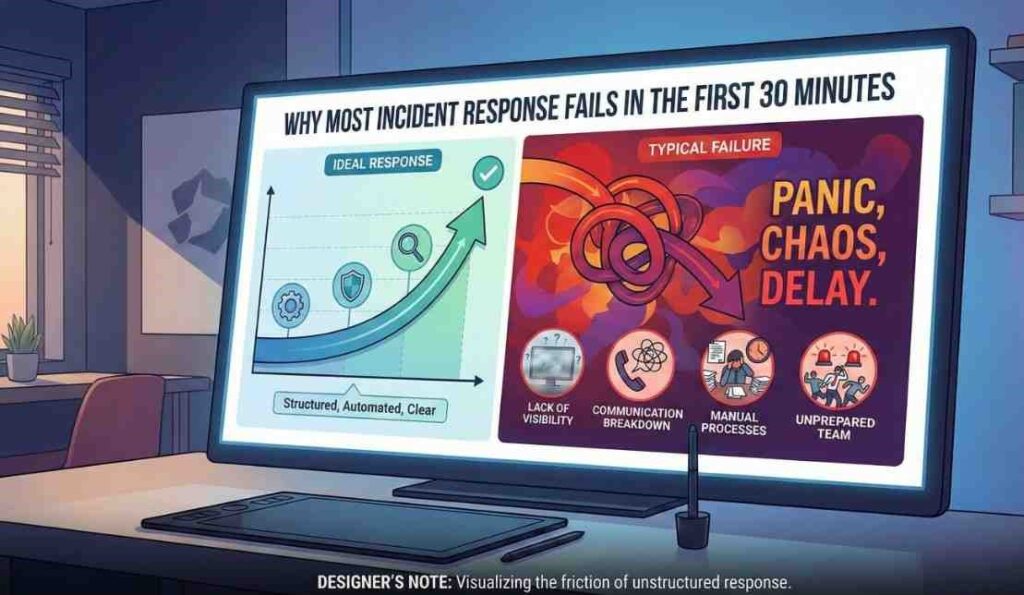
Incident response rarely collapses because teams lack tools, frameworks, or intent. In most environments, failure happens much earlier and much quieter than post-incident reports tend to admit. The first 30 minutes are not where organizations lose technical control. They are where they lose operational clarity.
At Invield, this pattern appears repeatedly across industries and maturity levels. The specifics of the incident change cloud compromise, credential misuse, lateral movement, ransomware staging, but the early moments look strikingly similar. Confusion surfaces before certainty. Silence replaces coordination. Action is delayed in the name of caution, even as risk quietly expands. Understanding why this happens requires stepping away from checklists and looking closely at how real incidents unfold under pressure.
The First Alert Is Rarely the Real Problem
Most incidents do not begin with a dramatic breach of notification. They start with something smaller and less convincing. An unusual authentication attempt. A spike in outbound traffic that could be legitimate. A workload behaving oddly after a routine change. The signal is real, but the meaning is unclear. This ambiguity is where the first cracks appear. Teams hesitate because the alert does not yet justify disruption. Nobody wants to shut down production, escalate to leadership, or trigger a response process prematurely. The assumption is that more investigation will bring clarity. What often goes unacknowledged is that attackers rely on this hesitation. The early phase of many breaches is designed to look uncertain rather than severe. By the time certainty arrives, the window for clean containment is usually closed.
The failure here is not technical. It is the absence of a shared understanding of how to act responsibly when information is incomplete.
When Ownership Becomes a Question Instead of a Given
In theory, incident ownership is well defined. In practice, the first 30 minutes often expose how conditional that ownership really is. Security detects something unusual but needs confirmation from cloud or infrastructure teams. Infrastructure waits for application context. Application teams wait for security to prove impact. Each team behaves rationally within its scope. Collectively, the response stalls. Modern environments amplify this problem. Cloud platforms blur boundaries between teams. DevOps accelerates change but diffuses accountability. Third-party services introduce dependencies that no single team fully owns. When an incident emerges, these structural realities surface instantly.
At Invield, one of the clearest indicators of early response failure is not a missed alert, but a delayed decision about who is empowered to act. Consensus feels safe in theory. In the opening minutes of an incident, it is often the most expensive option.
The Myth of “We Need More Evidence”
A common refrain during early response is the need for more confirmation. More logs. More correlation. More certainty. While investigation is essential, the belief that decisive action must wait for complete evidence is one of the most damaging assumptions in incident response. In the first 30 minutes, evidence will always be partial. Logs lag. Telemetry contradicts itself. Attack paths are still forming. Waiting for clarity that cannot yet exist creates a false sense of diligence while time quietly works against the organization.
Effective response in this phase is not about being right. It is about being directionally sound. Early containment actions should be designed to be reversible, proportionate, and stabilized. The question is not “are we certain,” but “what action reduces risk while preserving optionality.”
Communication Delays That Quietly Multiply Risk
Communication breakdowns rarely look dramatic at first. They appear as small delays justified by caution. A message not yet sent. A call postponed until severity is confirmed. Leadership kept out of the loop “for now.” The intention is understandable. No one wants to escalate prematurely or create an unnecessary alarm. Yet in practice, these delays fragment understanding. Teams begin forming their own interpretations of the incident. Parallel investigations emerge. Assumptions replace shared facts. By the time communication becomes unavoidable, alignment has already eroded.
At Invield, well-handled incidents consistently show early, disciplined communication not because teams know everything, but because they acknowledge what they do and do not know. Calm transparency stabilizes response far more effectively than silent analysis.
Tools Don’t Fail, Context Does
Most organizations invest heavily in detection and response tooling. SIEMs, EDRs, cloud security platforms, vulnerability scanners. These tools work as designed, yet early response still falters. The reason is not tool failure, but context overload. In the opening minutes, teams are flooded with signals but lack prioritization. Each tool highlights risk from its own perspective, leaving responders to manually reconcile competing narratives under pressure. Without clear context, teams default to chasing alerts rather than assessing impact. Activity replaces strategy. The response becomes busy but directionless.
Fatigue Begins Earlier Than Most Teams Expect
Incident fatigue is often discussed as a late-stage problem, after hours of response. It begins almost immediately when early actions lack clarity. The cognitive load of the first 30 minutes is intense. Rapid decision-making. High stakes. Uncertain outcomes. When teams spend that energy negotiating ownership, debating severity, or reconciling conflicting data, they deplete focus before the incident even peaks. This early exhaustion shapes everything that follows. Decision quality narrows. Reassessment becomes harder. Teams become defensive of early assumptions rather than adaptive to new information. Strong incident response preserves mental bandwidth early by removing friction where it matters most.
What Effective First 30 Minutes Actually Look Like
In environments where incidents are handled well, the opening phase looks quieter, not louder. There is a clear acknowledgment that something is wrong, even if the scope is unknown. An incident lead is recognized early, not because they have all the answers, but because someone must hold direction. Actions focus on stabilization rather than resolution. Containment steps are chosen carefully to limit potential damage without committing irreversible changes. Communication is factual, calm, and continuous.
Most importantly, uncertainty is treated as expected, not as a failure. Teams act with discipline precisely because they know clarity will come later.
This Is a Systems Problem, Not a People Problem
It is tempting to attribute early incident response failures to individual hesitation or poor judgment. That framing is comforting and misleading. What fails in the first 30 minutes is usually the system surrounding the people. Ambiguous ownership models. Fragmented visibility. Processes designed for audits rather than emergencies. These conditions shape behavior long before an incident begins. Improving early response requires treating it as an operational capability, not a checklist.
It means designing environments that support decisive action under stress, rather than assuming people will compensate through effort alone.
Getting the First 30 Minutes Right
At Invield, the first 30 minutes are viewed as the most honest reflection of an organization’s security posture. They reveal whether detection, context, and response are truly aligned or merely documented. Our approach emphasizes reducing ambiguity before incidents occur. This means helping teams understand which risks matter most, ensuring visibility is unified rather than fragmented, and clarifying response ownership, so decisions do not stall when pressure rises. The objective is not to speed for its own sake, but calm control when clarity is limited.
Invield encourages organizations to design early responses around stability. The goal is not to identify every detail immediately, but to create space for informed decisions by limiting impact early. When teams are supported by clear context and practical response paths, the first 30 minutes become a foundation rather than a liability.
Most incident response failures are not the result of poor effort or missing tools. They are the outcome of systems that were never built to support decisive action under uncertainty. By addressing that gap, organizations can change the trajectory of incidents before they fully unfold.
In the end, incident response is defined less by how it concludes than by how it begins. The first 30 minutes quietly shape everything that follows. Getting them right is not about perfection; it is about preparedness that works in the real world.

Comments
Post a Comment